Tailoring your CV to a job ad: how to optimise your CV for every application
Many candidates send the same CV to 20 or 30 different roles. That is exactly where applications lose ground – not because the qualification is missing, but because the relevant experience for this one role is not visible fast enough.
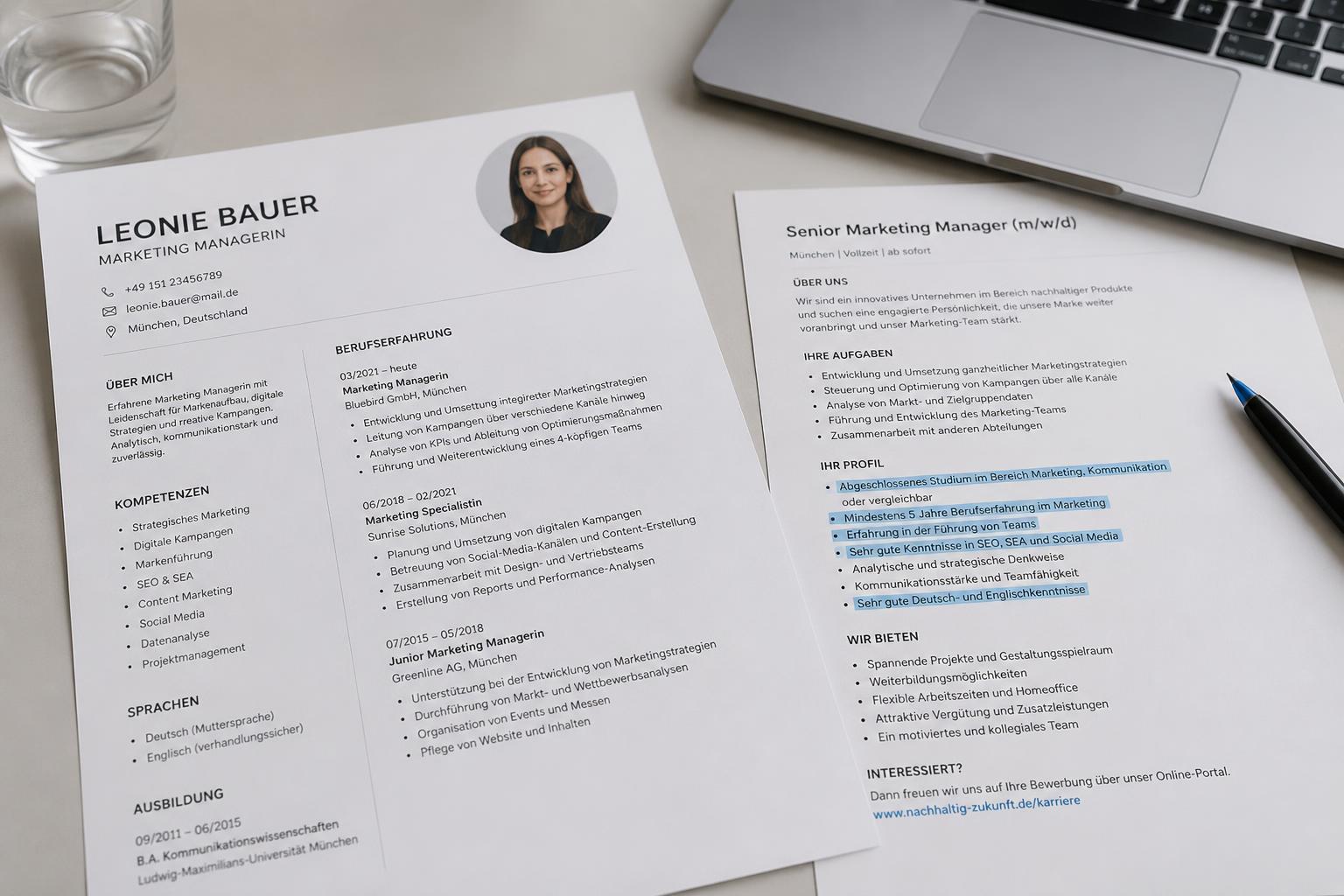
You do not need to rewrite your CV for every application. But it should be adjusted so that the relevant experience, skills and terms for this specific role are recognisable within seconds.
There is an important limit: this is not about inventing qualifications or stuffing your CV with terms from the ad. It is about presenting the experience you actually have in a way that matches the advertised role.
This article covers the step after analysing the job ad: what exactly do you change in your CV? How to analyse a German job ad systematically is covered separately in our article on reading job ads.
Why one CV is not optimal for every role
Two roles with the same job title can have completely different priorities. A marketing position in e-commerce looks for performance and analytics, one in a mid-sized company for content, trade fairs and customer communication. A generic CV only answers half of each.
Recruiters read a CV very quickly in the first round. They do not check whether you did something relevant at some point; they check whether the required experience is immediately findable. If the relevant point sits fifth under your third role, it is often missed at this stage.
In parallel, many companies use applicant tracking systems. These read text and structure and compare them with the requirements. If the common terms for tools, methods or qualifications are missing, the match rate drops – even when the experience exists. Our page on the ATS score explains how this works.
A good CV therefore has to serve both: a system that looks for terms and structure, and a person who decides in seconds.
- Different roles weight requirements differently
- Recruiters look specifically for the experience named in the ad
- ATS systems rely on terms, headings and date formats
- Relevant details disappear between side topics in a generic CV
- The CV has to stay readable for software and for humans
Step 1: Identify the key requirements in the job ad
Before you open your CV, you need a short, ordered list of what the role actually asks for. Copy the ad into an empty document and sort the requirements into categories.
Example of a fictional ad: a marketing manager with experience in Google Analytics, SEO, content marketing and campaign management, English B2/C1, at least three years of experience, HubSpot knowledge an advantage.
That gives a clear ranking: the must-haves are experience, SEO, content marketing, campaign management and English. HubSpot is desirable but not mandatory. This order later determines what belongs at the top of your CV.
- Must-have requirements: phrased as prerequisites, often with years or a qualification
- Desirable qualifications: „von Vorteil“, „idealerweise“, „wünschenswert“
- Tools and software: named systems such as Google Analytics 4, HubSpot, SAP, Datev
- Technical skills: methods, processes, subject areas
- Soft skills: communication, ownership, teamwork
- Experience: number of years, industry, scope of responsibility
- Languages: level according to the European framework
Step 2: Compare the relevant keywords with your own CV
Put your requirements list next to your CV and mark where each point is evidenced. Three outcomes are possible: the point is clearly visible, it exists but is phrased vaguely, or it is genuinely missing.
The second category matters most. The experience is already in the CV, just not in the words being searched for.
Job ad: „Experience with Google Analytics 4 and data-driven campaign optimisation“. Weak CV version: „Analysis of marketing activities“. Improved version: „Analysis and optimisation of digital marketing campaigns with Google Analytics 4“.
The underlying rule is simple: only use a term if it genuinely applies. If you only worked with Universal Analytics, write that. A term you cannot explain in a technical interview costs more than it gains in screening. Our overview of ATS keywords shows which terms are common in the German market.
- Visible: nothing to do
- Present but vague: rephrase precisely and use the common term
- Genuinely missing: do not add it; address it in the cover letter if relevant
Step 3: Prioritise your work experience correctly
In most cases you add no new content when tailoring. You change order, length and wording.
Start with your current role and the one most relevant to the job. Move the tasks that match the must-have requirements into first and second position. Tasks with no link to the target role get shortened or merged into one bullet. Three to five bullets per role are almost always enough.
Name concrete results where you can back them up: budget size, team size, reach, timelines, volumes. Numbers make a statement verifiable and lift it above interchangeable phrasing.
Before – Marketing Manager: responsible for various marketing tasks; creating content; evaluating campaigns.
After – Marketing Manager: planning and managing digital marketing campaigns; creating SEO-optimised content for the German market; analysing campaign performance with Google Analytics 4; optimising campaigns against defined KPIs.
The work itself is identical in both versions. What changed is whether a recruiter finds the ad's requirements in it. Our page on CVs with several years of experience shows how to weight roles across a longer career.
Step 4: Adapt your skills section to the role
A list of 20 to 30 skills looks complete but says little. The longer the list, the less weight each entry carries – and the more likely the reader misses the one term that matters for this role.
Move the five to eight skills named in the ad to the front. Everything else can sit below or be dropped if it adds nothing for this position.
For the marketing role in the example that would be: SEO · Google Analytics 4 · Content Marketing · HubSpot · campaign management.
Keep technical skills, languages and soft skills separate. State language levels explicitly, for example German C1 or English B2. Soft skills are only worth listing when the ad explicitly asks for them and your experience reflects them.
Step 5: Review your job title and profile
The professional title under your name and the short profile at the top are the first lines anyone reads. They should fit the target role without misrepresenting your actual position.
Instead of a generic „Marketing Professional“, something like „Digital Marketing Manager | SEO & Content Marketing“ is far more informative – provided it is accurate – because it picks up the ad's priorities.
Two or three sentences are enough for the profile: professional field, relevant years of experience, two areas of focus and the industry if useful. Everything stated there must be evidenced further down.
Again, explicitly: do not invent job titles, academic degrees or qualifications. A title that does not match the real position shows up at the latest in your reference letter or the interview.
How much should you change for each application?
The practical answer: you do not need a brand new CV. Keep a complete master version with all roles, tasks and skills. For each application you create a shortened, reordered version from it.
In most cases five edits are enough, and 10 to 20 minutes is realistic.
- Check the relevant keywords from the ad and sharpen existing wording
- Reorder the bullets in your two most relevant roles
- Sort skills by relevance for this specific position
- Align the short profile and professional title with the role
- Cut irrelevant content so the CV does not get longer
ATS optimisation: why keywords alone are not enough
An ATS-friendly CV is not one with as many keywords as possible. These systems read the whole text and its structure. If headings are missing, dates are inconsistent or content sits in tables, headers or graphics, information is lost – no matter how many matching terms it contains.
We have collected the common causes of poor readability on our page about why ATS systems reject applications. The basics of a cleanly readable document are on the ATS-friendly CV page.
The second half of the process matters just as much: a high match score does not mean an invitation. After the system, a human reads. The CV must not only contain the right terms, it also has to convince on substance.
- Clear, conventional headings such as experience, education, skills
- Roles in reverse chronological order with consistent dates (MM/YYYY)
- Flowing, selectable text instead of graphics, text boxes or multi-column tables
- Job titles that match common usage
- Terms used in the context of a task, not as an isolated list
- No keyword stuffing and no hidden words in white text
5 mistakes when tailoring a CV
These five patterns are the ones we see most often – and they cost more applications than a missing certificate.
- Adopting keywords although the knowledge is not there
- Copying whole sentences from the ad, which makes the CV sound impersonal
- Overloading the CV with terms so the actual achievements disappear
- Only changing the skills list while leaving the experience section untouched
- Still sending exactly the same file for every role despite good intentions
Example: job ad → tailored CV
Requirement in the job ad
- SEO experience
- Google Analytics 4
- Content marketing
- Campaign analysis
Visible in the CV
- SEO optimisation of website content
- Google Analytics 4
- Planning content marketing campaigns
- Analysing campaigns against relevant KPIs
Only mirror requirements that match your actual experience. Points you cannot back up stay out – they are better placed in the cover letter or the interview.
Checklist before you send
Work through these eight points before submitting. They extend the general application checklist with the part that relates to this specific role.
- Have I identified the key requirements of the ad?
- Is the relevant experience visible at first glance?
- Am I using the matching terms from the job ad?
- Are all the skills I list genuinely mine?
- Are the most important bullets at the top of each role?
- Is the CV clearly structured and ATS-friendly?
- Have I checked spelling, dates and contact details?
- Does the CV really fit this position – not just the industry?
Comparing your CV against a job ad automatically
Manual comparison works well but takes time, and it occasionally misses terms that appear only once in the ad.
With Apply Germany you can analyse your CV together with the job ad. The result shows in particular:
- how well your CV and the position match in substance
- which relevant terms from the ad are still missing
- which sections can be improved for this role
- how an ATS and a recruiter are likely to assess the CV
Conclusion
Writing a completely new CV for every application is neither necessary nor useful. What should change is the focus: which experience sits at the top, which terms you use, which skills come first.
The strongest applications do not show as many qualifications as possible; they make the qualifications relevant to this specific role immediately visible. Everything else stays in the master version and becomes relevant again for the next application.
If you want to review the structure of your document in general, our overview of CVs in Germany and the guide to applying in Germany are good starting points.
CV in Germany ATS keywords ATS score explained ATS-friendly CV Why ATS rejects applications CV with work experience Applying in Germany Application checklist Article: how to read a job ad Article: CV keywords
Frequently asked questions
Do I have to tailor my CV for every application?
For serious applications yes, but only in parts. A complete master version stays your base; per role you adjust the short profile, the order of tasks and the skills. That usually takes 10 to 20 minutes.
Which keywords belong in a CV?
Mainly concrete terms: tools and software, methods, subject areas, job titles, certificates and language levels. General traits such as motivated or team player are not keywords and add nothing to the match.
Can I take terms directly from the job ad?
You can reuse individual technical terms, tool names and job titles exactly as the ad spells them, as long as they apply to your experience. Copying whole sentences sounds impersonal and recruiters notice it.
How many keywords should a CV contain?
There is no fixed number. Cover the key requirements of the ad and mention each term in the context of a concrete task. Repeating terms without context does not improve the result.
Can I use the same CV for several roles?
For very similar positions in the same field one version often works well. As soon as focus, industry or tools differ, a tailored version pays off.
How do I spot important ATS keywords in a job ad?
Look for terms mentioned repeatedly or in the „Ihr Profil“ section, for names of software and methods, and for requirements with numbers such as years of experience or language levels. These are the details systems can evaluate reliably.
How long does it take to tailor a CV to a role?
With a well-maintained master version, 10 to 20 minutes is realistic. The main effort is a one-off when creating the base version, not when tailoring it.
How well does your CV match the job?
Upload your CV and the job ad and see within minutes which keywords are missing – free and without signing up.