Applying in Germany: how to optimise your CV, cover letter and ATS readability
An application in Germany is more than a good CV. Structure, relevant experience, a clear link to the job ad, the cover letter, the file format and technical readability all influence whether your documents convince.
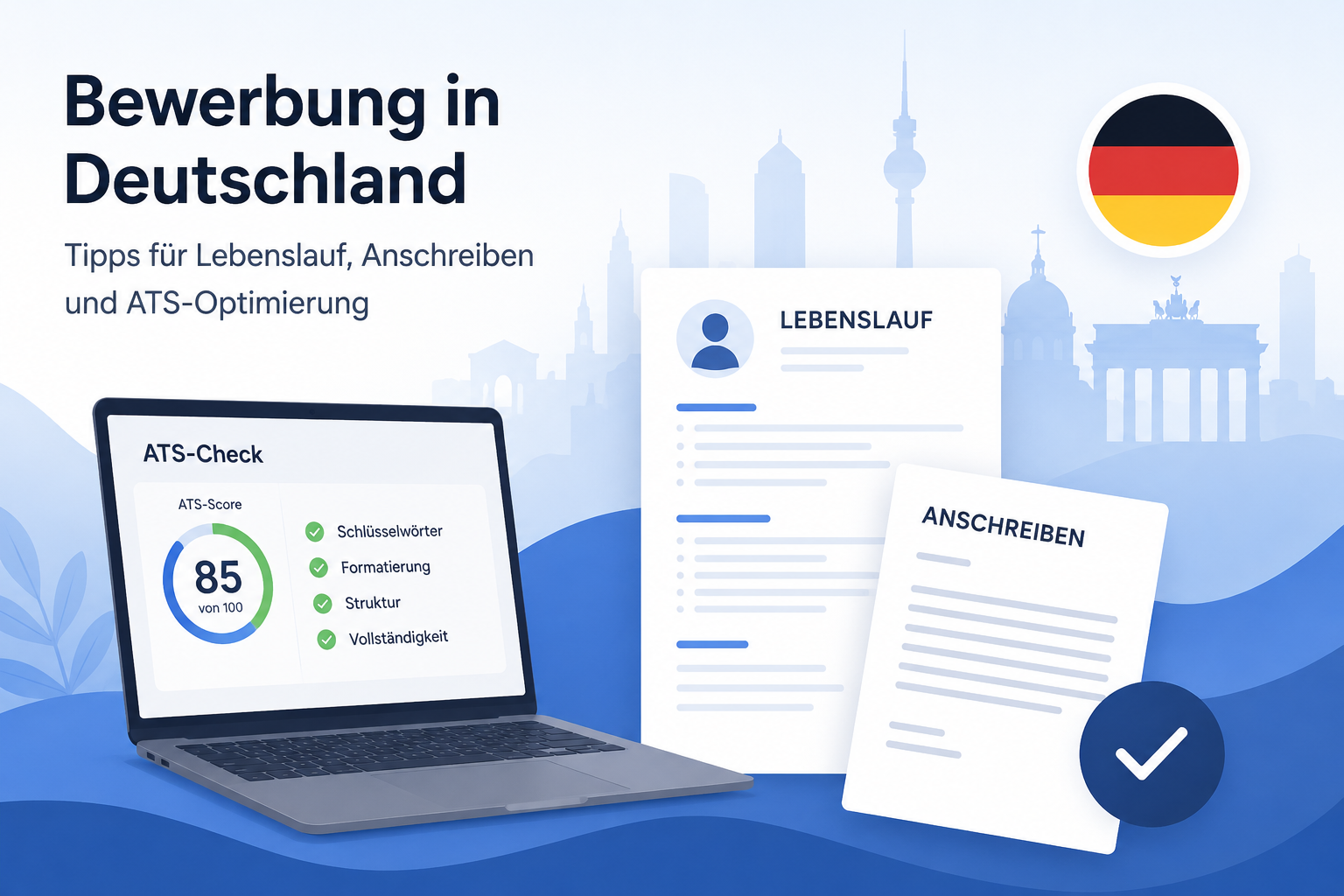
When you apply in Germany, qualifications alone rarely decide the outcome. What matters just as much is how clearly your documents show that your experience fits this specific role.
Most companies now use digital hiring processes and applicant tracking systems (ATS). Applications are uploaded, stored, searched and forwarded inside such systems. Your CV should therefore be pleasant to read for people and cleanly structured for software.
This guide walks you through the whole application process in Germany: which documents are expected, how to structure your CV, how to write the cover letter, how to use keywords, which file format to choose and what to check before you hit send.
What belongs in an application in Germany?
The scope of application documents differs by company, industry and job ad. In practice, these parts are usually relevant:
- CV – almost always required
- Cover letter – if requested or genuinely useful
- References and certificates of employment, degree certificates
- Certifications, where relevant to the role
- any other explicitly requested documents, e.g. portfolio, publication list or recognition decision
Your CV is the core of the application
The CV often decides within seconds whether an application is taken further. A CV for German companies is factual, clearly structured and reverse-chronological – the most recent role comes first.
A complete CV includes:
- Contact details: name, address (optional), phone number, email
- Work experience with dates, employer, job title and a few meaningful tasks
- Education or studies with degree and dates
- relevant skills, tools and methods
- language skills with a realistic level
- certifications and training, where relevant to the role
Tailor your CV to the job ad
Sending the exact same CV everywhere is one of the most common reasons for rejections – not because a standard CV is bad, but because it does not show which experience matters for this particular role.
An example: a job ad asks for project management, SAP and process optimisation. If you genuinely have that experience, it should be clearly visible in your CV – in your task descriptions, in the skills section and, if appropriate, in your short profile.
Important: never invent qualifications or experience. The goal is only to present existing experience more precisely and make it easier to find.
- Highlight the requirements in the job ad and compare them with your profile
- Describe relevant roles in more detail and shorten less relevant ones
- Name tools and methods exactly as the industry does
- Keep job titles understandable rather than creative
What does ATS have to do with your application?
An applicant tracking system (ATS) is software companies use to organise applications: documents are parsed, information is stored in structured fields, applications are linked to vacancies and shared internally. Larger companies can also search or sort applications inside the system.
That does not mean software decides about your application. It does mean your CV should be technically easy to parse – otherwise information ends up in the wrong field or gets lost.
The following helps most:
- clear headings such as “Work experience” or “Education”
- clearly recognisable roles with complete dates
- a readable, single-column base structure
- relevant terms from the job ad inside the actual text
- no unnecessarily complex design with graphics, text boxes or contact details in the header
ATS explained: how applicant tracking systems work Create an ATS-friendly CV
Using keywords in your CV correctly
Terms from the job ad can and should appear in your CV – but only if they match your actual experience. Keywords work best inside your task descriptions rather than in a loose list.
Job ad
Experience with SAP S/4HANA and process optimisation
Weak
Used various IT systems.
Better (if factually correct)
Used SAP S/4HANA for order processing and process optimisation.
Keywords should sharpen existing experience – never invent it.
The cover letter: individual instead of generic
Not every job ad asks for a cover letter. When it does, it should complement your CV instead of repeating it. Four questions are enough as a framework:
- Why exactly this position?
- Why this company?
- Which of your experiences fit the requirements particularly well?
- What concrete value do you bring to day-to-day work?
German cover letter: structure and wording Do you still need a cover letter in 2026?
PDF or DOCX – which format is better?
In short: the job ad always takes priority. Without a requirement, PDF is usually the safer choice because the layout stays intact. DOCX may be explicitly requested or useful for further processing in some hiring workflows.
For ATS compatibility, the file format is not the only factor anyway – the document structure matters more: clear sections, real text instead of images and a simple layout.
Common application mistakes
These points cost candidates the interview most often:
- one generic CV for every role
- relevant skills are hard to spot
- cluttered structure without clear sections
- unnecessarily complex layout with columns, graphics or tables
- important keywords are missing although the experience exists
- the cover letter merely repeats the CV
- wrong file format despite instructions in the job ad
- spelling or formatting mistakes
Check your application before sending
This checklist takes a few minutes and prevents most avoidable mistakes:
- Are all contact details correct and reachable?
- Is the CV up to date and complete?
- Is relevant experience recognisable within seconds?
- Does the CV match this specific role?
- Are relevant keywords included, where they genuinely apply?
- Is the cover letter tailored to the role and company?
- Did you use the requested file format?
- Are all requested documents attached?
- Have spelling and formatting been checked?
- Is the CV technically readable (real text, clear headings)?
Check your CV for free with Apply Germany
Want to know how well your CV matches a specific job? With the free ATS check from Apply Germany you can analyse your CV together with a job ad and receive, among other things, an ATS score, hints on relevant keywords and concrete suggestions for improvement.
With Premium you additionally receive an optimised CV, an individual application, a recruiter review and further content tailored to the job ad.
Frequently asked questions
What makes a complete application in Germany?
Usually a CV and – if requested – a cover letter, plus references, proof of education and relevant certifications. The job ad normally states which documents are expected.
Do I have to tailor my CV for every application?
You do not need to rewrite it. It does help to highlight the experience, skills and terms from the job ad more clearly, as long as they genuinely apply to you.
Is PDF or DOCX better for applications?
If the job ad does not specify a format, PDF is usually the safer choice because the layout stays intact. If DOCX is requested, use DOCX.
How do I know whether my CV is ATS-friendly?
Good signs are a single-column structure, clear headings, complete dates and real text instead of images. The free ATS check from Apply Germany also shows which relevant keywords are missing.
How well does your CV match the job?
Upload your CV and the job ad and see within minutes which keywords are missing – free and without signing up.